The pattern patients rarely mention
Difficulty swallowing rarely arrives in clinic as such. It arrives disguised as habits: chewing far more than usual, washing every mouthful down with water, leaving the meat on the plate, always being last to finish, avoiding certain restaurants.
These adaptations settle in so gradually that they stop registering as a problem. That is why diagnosis is delayed for years.
The episode that usually triggers everything is an impaction: a piece of food that lodges and forces a visit to the emergency department.
What eosinophilic oesophagitis is
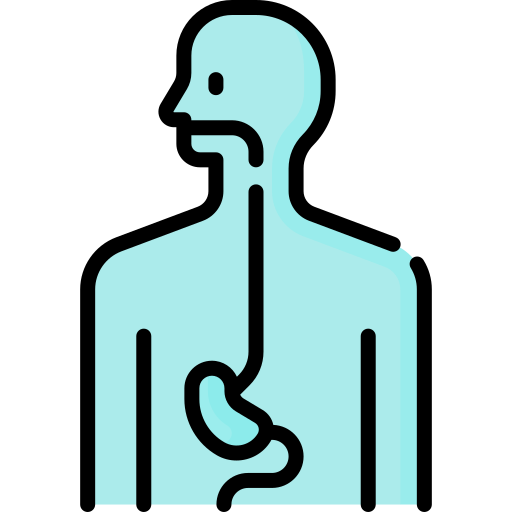
It is a chronic inflammatory condition of the oesophagus with an allergic basis. A particular defensive cell, the eosinophil, accumulates in the oesophageal wall and sustains inflammation that, over the years, stiffens and narrows the passage.
It is now the leading cause of difficulty swallowing and food impaction in younger adults, and its frequency has risen markedly over the past two decades.
Why it is mistaken for reflux
The symptoms overlap and many patients receive antacids for years. The difference is that the problem here is not acid but allergic inflammation. And it is only visible on biopsy, even when the oesophagus looks normal to the naked eye.
Signs pointing to this diagnosis
- A sensation that food stops in the chest, particularly meat and bread
- Choking episodes, sometimes requiring emergency care
- Needing to drink a lot of water or chew extensively in order to swallow
- Avoiding certain foods without consciously deciding to
- Heartburn or chest pain that does not improve with acid suppression
- Personal or family history of asthma, rhinitis or food allergy
How it is diagnosed
There is only one way: a gastroscopy with biopsies of the oesophagus, taken from several levels. The diagnosis is confirmed when fifteen or more eosinophils per high-power field are counted.
And here is the critical point: in up to a third of cases the oesophagus looks normal during endoscopy. If biopsies are not taken, the diagnosis is missed and the patient leaves with a report saying everything is fine.
Treatment works
Several effective routes exist, and the choice depends on your situation and preferences rather than a fixed rule.
- High-dose proton pump inhibitors. Simple and effective in a proportion of patients
- Swallowed topical steroids. Formulations designed to act on the oesophagus with minimal absorption
- Elimination diet. Stepwise withdrawal of the foods involved, with controlled reintroduction
- Biologic treatment. For cases not responding to the above
- Endoscopic dilation. When a narrowing is already established
Whichever route is taken, response must be confirmed with a repeat endoscopy and biopsies. Feeling better does not mean the inflammation has gone, and it is that inflammation which narrows the oesophagus in the long run.
Why it is worth not leaving it
This is a condition with years of average delay between the first symptom and the diagnosis, and with treatment that works well once applied. That combination is what makes the delay so regrettable.
The sooner inflammation is controlled, the less likely it is to end up with a narrowed oesophagus requiring repeated dilations.
If you recognise the pattern of eating slowly, constantly drinking water or avoiding certain foods, it is worth investigating.